
Southern California’s Enduring Theatre Scene: A Look at L.A.’s Stages
Discover the vibrant and resilient theatre landscape of Southern California, focusing on the dynamic array of plays and performances thriving across Los Angeles.
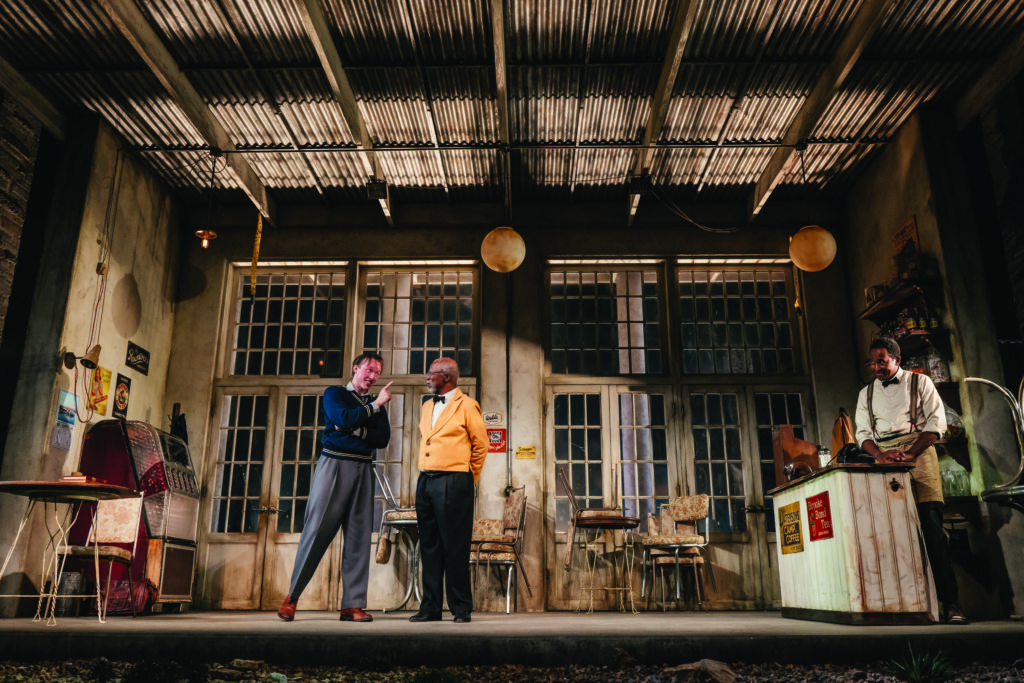
Ben Beatty, John Kani, and Nyasha Hatendi in 'Master Harold...and the Boys' at Geffen Playhouse. (Photo by Jeff Lorch)
A Tale of Three Cities | Fall 2026 | Features
September 28, 2026 Steven Leigh Morris Leave a comment
L.A.’s Runway Project
The state of play(s) in Southern California, where the theatre refuses to die.
By Steven Leigh Morris
In assessing the state of Southern California’s sprawling theatre scene, contradictions emerge. Most are struggling; some are not. Some find that new plays keep audiences away; for many, new work is the draw.
Across the board, for all their challenges with audiences, buildings, and contracts, nobody in Southern California—where the local film and TV industry has faced its own recessionary pressures—believes that the theatre is dying. That’s probably as good a place as any to start.
View From Above
Theatre leaders told me that audiences have been returning post-Covid, though still not yet at pre-pandemic levels. Meanwhile, federal cuts at important agencies have led foundations to reassess priorities, in some cases squeezing out nonprofit theatres. As Barry Edelstein, artistic director at San Diego’s Old Globe Theatre , put it: When he talks to corporate funders and foundations, “They say, ‘Cancer research.’” Edelstein also described rising costs that are symptomatic at theatres across the region, large and small. “When I got here 14 years ago, a four-character play in a 250-seat theatre might break even,” he said. “Now that same show loses $150,000.”
Theatre reflects the culture it occupies. The fracturing of the culture into tribes within bubbles has an indisputable parallel in live theatre. Pasadena Playhouse producing artistic director Danny Feldman looks back to 1965, when a musical film like The Sound of Music could unite generations, from teens to octogenarians. “We’re at a moment in history, because of self-curation and digital tech, where the tastes of the old guard have never been more different from the tastes of the young guard,” Feldman said. “How do we carry all of the buckets?”
Times have been particularly tough for L.A.’s smaller theatres, once dominant throughout the county. In the past decade, productions at these companies have shriveled, based on a comparison of stage listings from the digital journal Stage Raw in 2015 and 2026. One reason is the highly contested policy of the stage actors’ union, Actors Equity Association, which in 2015 eliminated the region’s long-standing 99-Seat Theatre Plan . That plan, which permitted union actors to perform in intimate theatres of 99 seats or fewer as volunteers working for stipends, led to a boom—some would say a glut—of productions from the 1980s through the 2000s. The union’s goal in rescinding that deal, to foster more contract weeks for Equity actors, doesn’t seem to have borne fruit. Instead most small companies are simply producing fewer shows.
A second blow came in 2020 with State Assembly Bill 5 , which mandates that, with a few exceptions, every theatre worker in California is entitled to minimum wage, drawing payroll taxes paid by the employer (the theatre). Jon Lawrence Rivera, who’s about to retire after a 34-year run as artistic director of the new-work-fostering Playwrights Arena , laid out the math: A play in a 35-seat theatre with six characters cost $20,000 in 2019; it now costs around $80,000. The troupe’s entire annual budget is $150,000. Rivera’s successor, Elmira Rahim, is struggling to keep the company solvent and meaningful.
Snehal Desai, artistic director of the region’s flagship theatre, Center Theatre Group (CTG), said he’d love to tap the new plays being developed by L.A.’s smaller theatres, but there are fewer to choose from. Pasadena Playhouse’s Feldman put it succinctly: “You can’t have the major leagues without the minor ones.”
Triumphs and Conundrums
Desai is now in his third season running CTG, which presents plays in three separate buildings of 2,084 seats, 739 seats, and 317 seats, respectively. When he arrived at the post in 2023, CTG was in free fall. Massive staff layoffs accompanied the controversial decision to suspend programming for a year while the company regrouped. (Its current budget sits at $50 million.) Last season, Desai’s attempt to stanch the blood loss was to program a season of culturally diverse hits, almost all imported from New York and London. As a commercial strategy, it worked; audiences roared back.
In the midst of all the Broadway and West End imports, Desai holds out hope that in the future he can take advantage of CTG’s third space, the Kirk Douglas Theatre in Culver City, to present locally generated new work with such smaller troupes as IAMA Theatre Company , Deaf West Theatre , East West Players , Latino Theater Company , Ammunition Theatre Company , and Four Larks . He talks about the “long runway” of educating audiences about the value of new voices. That’s what used to be called investment—and leadership.
Over at the official State Theatre of California (the official designation of the century-old, 686-seat Spanish Colonial-style Pasadena Playhouse), Feldman, who helped oversee the nonprofit’s recent purchase of the building from the city, said that ticket sales cover between 40 to 60 percent of expenses. He’s working to bridge that gap with adult education programs of up to 400 students per semester.
Feldman does have a commercial streak in his programming, but that doesn’t always mean “safe.” He believes in “taking big swings,” he said. “You don’t raise money by begging. You raise money by leading.” He admitted that the theatre has struggled with new plays, which don’t draw the crowds the organization needs to stay afloat. But Feldman argued that he’s aiming for more than crowd-pleasers. “If our goal is to build the largest subscription-based audience, we’ll look like A Noise Within, staying in our lane.”
Also in Pasadena, A Noise Within —a solid, reliably conservative purveyor of established works in repertory—is one in a cluster of once intimate theatres ( South Coast Repertory , L.A. Actors’ Theatre, East West Players, International City Theatre ) that graduated to mid-size status some time between 1967 and 2011.
Crosstown in Westwood is the Geffen Playhouse , a two-theatre complex (512 and 149 seats) with a thoughtful playwright, Tarell Alvin McCraney, at the helm since 2023. He said he aims to balance the hunger for crowd pleasers by also presenting “important plays” that may not appeal to a broad audience. McCraney’s own The Brothers Size was programmed off-subscription as a special event. “We knew that was a different experience: a play with live music and street poetry,” he explained. “It started in the lobby and moved inside.”
Like most good leaders, McCraney is learning to swim upstream. A thousand new subscriptions came in last year, according to the Geffen’s executive director and CEO Gil Cates Jr., though the theatre lacks deep-pocketed industry donors, and last year’s Palisades fires drove a swath of Geffen subscribers from L.A.’s Westside. But, said Cates, “I still see the opportunity as larger than the challenges.”
Down the 405 freeway from the Geffen Playhouse, some 47 miles into Orange County, stands the three-theatre complex (507, 336, and 94 seats) of the Tony Award-winning South Coast Repertory , which has a storied legacy of developing new works, including with its annual Pacific Playwrights Festival .
Artistic director David Ivers arrived in 2018, not long before Covid struck, and his managing director, Suzanne Appel, is just now starting her second season. SCR’s audiences, largely from suburban OC burgs, skew white and older, Appel explained. But that doesn’t describe the demographics of the whole region, or its future—hence the theatre’s active education and community outreach programs. Quipped Ivers: “Forty years ago, we asked, ‘What are we going to do to bring in new audiences?’” On rare occasions, the more things stay the same—the more they stay the same.
Tales of the City-Owned
Meanwhile, who says local governments can’t support the arts? Three city-owned theatres report robust financial health, and others are making it work with municipal help.
La Mirada Theatre , located in a suburb in southeastern L.A. County, is owned and maintained by La Mirada. But the city subcontracts programming for the 1,251-seat space to McCoy Rigby Entertainment (MRE), which takes a fee for producing a season of almost entirely Broadway musicals and hit plays. The city takes 100 percent of the box office revenue and pays 100 percent of production expenses. With 22 performances per show and five shows a season, that is more than sufficient to meet production costs, despite the exponential rise in those costs, said MRE’s Tom McCoy.
Meanwhile, in the heart of Downtown Los Angeles, the city-owned Los Angeles Theatre Center (LATC), a historic complex of five theatres in an eight-story former bank building, tells another success story with a different model. Under a long-term lease with city to maintain and operate the facility is José Luis Valenzuela’s Latino Theater Company (LTC). The city neither pays for the building’s maintenance, which Valenzuela put at about $500,000 a year, nor takes any of the box office revenue. In a contradiction of the prevailing wisdom that new plays don’t draw audiences, LTC presents a swath of commercially successful new works coming largely from a cadre of in-residence playwrights called the Circle of Imaginistas. LTC commissions and develops their plays, then presents them in one of three theatres (496 seats, 318 seats, or 99 seats).
“When new plays speak directly and immediately to the concerns of a community, they find their audience,” Valenzuela said, pointing to this year’s twice-extended The Storyteller of East L.A. by Evelina Fernández, about a family whose matriarch is coping with Alzheimer’s. Looks like Valenzuela built that runway.
Yet another long-running company in a city-owned facility is Long Beach’s International City Theatre (ICT), now in its 41st season at the 825-seat Beverly O’Neill thrust stage, ensconced within the Long Beach Entertainment and Convention Center.
caryn desai took over artistic leadership of ICT in 2011 from her husband and artistic partner, Shashin Desai. Ticket sales at ICT average about one-half of expenses, desai reported, and with “careful budgeting,” and an annual budget of about $1.32 million, the theatre has “operated in the black for several seasons,” supplementing ticket sales with six grant-attracting education programs—mostly for youth, but also one for HUD-residing, low-income seniors.
Another runway builder, desai said that when you educate audiences about the excitement of new plays, they show up. In the past three seasons, ICT has presented world premieres by Luke Yankee, Wendy Graf, and Paul Webb.
Up the freeway, on L.A.’s Westside, John Ruskin and Mike Myers jointly run Ruskin Group Theatre (RGT), a newly built complex of two small theatres (99 and 65 seats) in a city-owned venue on the grounds of the Santa Monica Municipal Airport. With naming rights for theatres and seats, the duo raised $1.4 million, with the city kicking in another $3 million. They opened the larger space in February and the smaller one a month later.
Myers and Ruskin said they are currently trying to navigate a budget gap of 70 percent between ticket revenue and expenses (including $15,000/month rent). With their high artistic ambitions, though, the pair is unlikely to find savings by staging all solo performances and two-handers. As Myers put it, they have another decade on the lease to figure out the gamble they made with “enthusiasm and stupidity.”
Level Up
At the opposite corner of L.A. County, in a rapidly gentrifying district northwest of Downtown L.A. called Highland Park, sits Outside In Theatre . Though co-founders Daniel Blinkoff and Tamlyn Tomita initially envisaged it as a base for di
_Originally reported by [American Theatre](https://www.americantheatre.org/2026/09/28/l-a-s-runway-project/)._
Comments
Loading comments…