
Duncan Sheik Remembered: A Colleague Recalls His Mischief, Melancholy, and Melodic Gift
A longtime collaborator of composer Duncan Sheik shares memories of his colleague's spirited nature and somber reflections, alongside the innate musical talent he once overlooked.
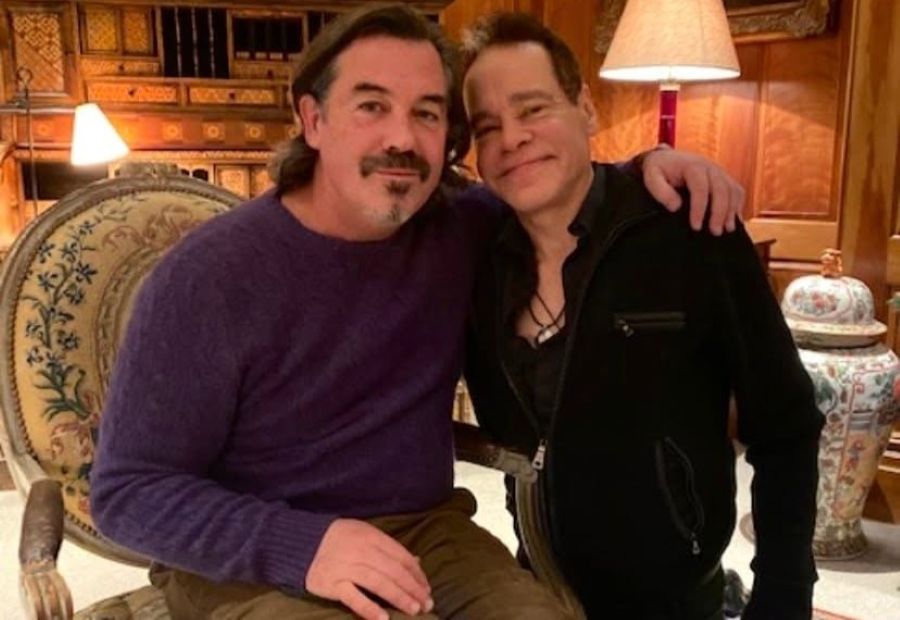
Duncan Sheik and Steven Sater in 2021.
In Memoriam
September 22, 2026 Steven Sater Leave a comment
For Duncan Sheik: Requiescat
The composer’s longtime collaborator remembers his colleague’s mischief and melancholy, and the melodic gift he took for granted.
By Steven Sater
Duncan Sheik, the Tony-winning composer of Spring Awakening , Alice by Heart , and American Psycho , died on Sept. 17. He was 56.
From the beginning—which already felt like “from always”— Duncan and I wrote about parting, grief, and loss. But also, through the saturnine tones of his harmonies, about yearning, about longing deferred, hope buried but hope enduring. From our first project, Phantom Moon : “And there was gone, and there was evermore, and there was ‘Wherefore hast thou?’”
Now I sit in a familiar London hotel room, a hotel where we spent so many nights, so many years, carousing; now I sit haunted by those harmonies, and of course by the memory of him making them. “Thou’lt come no more, no more for evermore, no more for evermore now.”
Through his last terrible afternoons in the ICU, I sat holding Duncan’s hand, chanting into his ear. Closer to him perhaps than ever I’d been. Certainly it was unlike him to be so patient!
Then, just as certainly, his work in the theatre, and the years of hope deferred in creating a new musical, taught even restless, striving Duncan some patience. Tomorrow, without him, we will finally begin rehearsals for Nero , a show we worked on together for the past 23 years.
It was on May 1st, 2003, as George Bush declared “Mission Accomplished” in Iraq, that I called and proposed creating a piece about Nero. His response: “Another piece of musical theatre?”
In fact, through all the years, through all the projects I pitched, all the lyrics I gave him, never once did Duncan say no. He would read through the lyric, tapping his fingers, finding the rhythm, counting and clocking the phonemes (which he always respected completely). Then he’d look up with those wild, brooding eyes, “Sure, it’s cool. Let me just see if Orpheus comes to me.” And of course Orpheus did. Invariably.
When Duncan set my lyrics, he set them verbatim. In “Totally Fucked,” he sang back the exact number of “Blaa”s I first gave him. And when, in “Left Behind,” I left him “O-O-O-O-O-O,” he simply found the inevitable ache within each precise note. (One of the last questions he asked me, just before he returned for the last time to the ICU: “But Steven, what exactly is the difference between ‘O’ and “Oh’?” I thought you’d never ask!)
But I am giving so wrong an impression of him personally. Yes, he had a rebel melancholy. Often, it seemed, he surveyed the world as if it revealed its true sadness only to him. But never have I met someone so alive, who laughed so hard, who had such a gallows wit. He had such an aching, mischievous spirit, and loved leaving people aghast.
When, after our first-ever workshop of Spring Awakening , an 80-year-old female board member at La Jolla Playhouse offered Duncan a note, he smiled that ribald smile: “So, you’re saying, you want more ‘fuck’s and fewer ‘blaa blaa blaa’s?”
Seven short years later: the Tony Awards, 2007. I’d delayed him taking his seat by enlisting him to find a bottled water with me. And so he’d only half sat down when his name was called for Best Orchestrations. His first words when he returned to that seat, after his cryptic acceptance speech: “Now you’d better fucking win.”
Backstage, 2024, meeting/greeting a brilliant young Broadway performer. The actor thanked us hard for coming, then asked, would we be going out after? “Who, us?” Duncan quipped. “No, I’ll be out at some strip club, and Steven will be home rereading Proust.” (Both things were true. But also true: The next morning, 10 a.m., he called to debate a point raised in Gibbon’s six-volume History of the Decline and Fall of the Roman Empire . And of course he had to be right, and to prove himself the more erudite.)
Just three months ago, spring 2026. I’d asked Duncan something about melody: “You know, I never really think about melody. All I’m good for are chord progressions. Harmonies. But one day I’m going to start to deal with melody, and then we’ll really be upping our game.”
Duncan, Duncan, Duncan. Not gone, no. But how can you leave us? You who, like Beethoven, never cared so much about melody and yet found, in a range of one to three notes, such a profound, and profoundly human, inevitability.
These sad past days, I’ve been called Duncan’s “closest collaborator.” And yet, for all the work, for all the years, all the travels, the hangs, the retreats, the dinners, I wonder if we ever actually collaborated. Rather, it was like we knew a twin solitude. Never did we write in a room together. Never did we talk through what we’d done or what we were about to do—or what assignment we were meant to do. No, as if in another room in our heads, we each somehow intuited what the other had meant. Always Duncan just understood.
And perhaps it’s that same sorry intuition, that mind-in-mourning wisdom, that still and always sounds in every chord.
Steven Sater is a Tony Award -, Grammy Award -, and Laurence Olivier Award -winning American playwright, lyricist, and screenwriter. His collaborations with Duncan Sheik include the 2006 Broadway musical Spring Awakening , Alice by Heart, the upcoming Nero, and the album Phantom Moon.
Further Reading
William Finn Knew What He Liked, and Made Plenty to Love
_Originally reported by [American Theatre](https://www.americantheatre.org/2026/09/22/for-duncan-sheik-requiescat/)._
Comments
Loading comments…